
In Need of Compliance and Certification Support?
If your company’s values and goals include compliance, we are here to help! Allay Consulting compliance services work one-on-one with your company to create realistic Safety & Quality Management Systems that are unique to your company’s values and goals. Contact Allay Consulting to learn more about implementing FDA compliance, cGMP/GACP/Organic system, OSHA safety compliance, written documentation, facility compliance, certification readiness, and employee education.
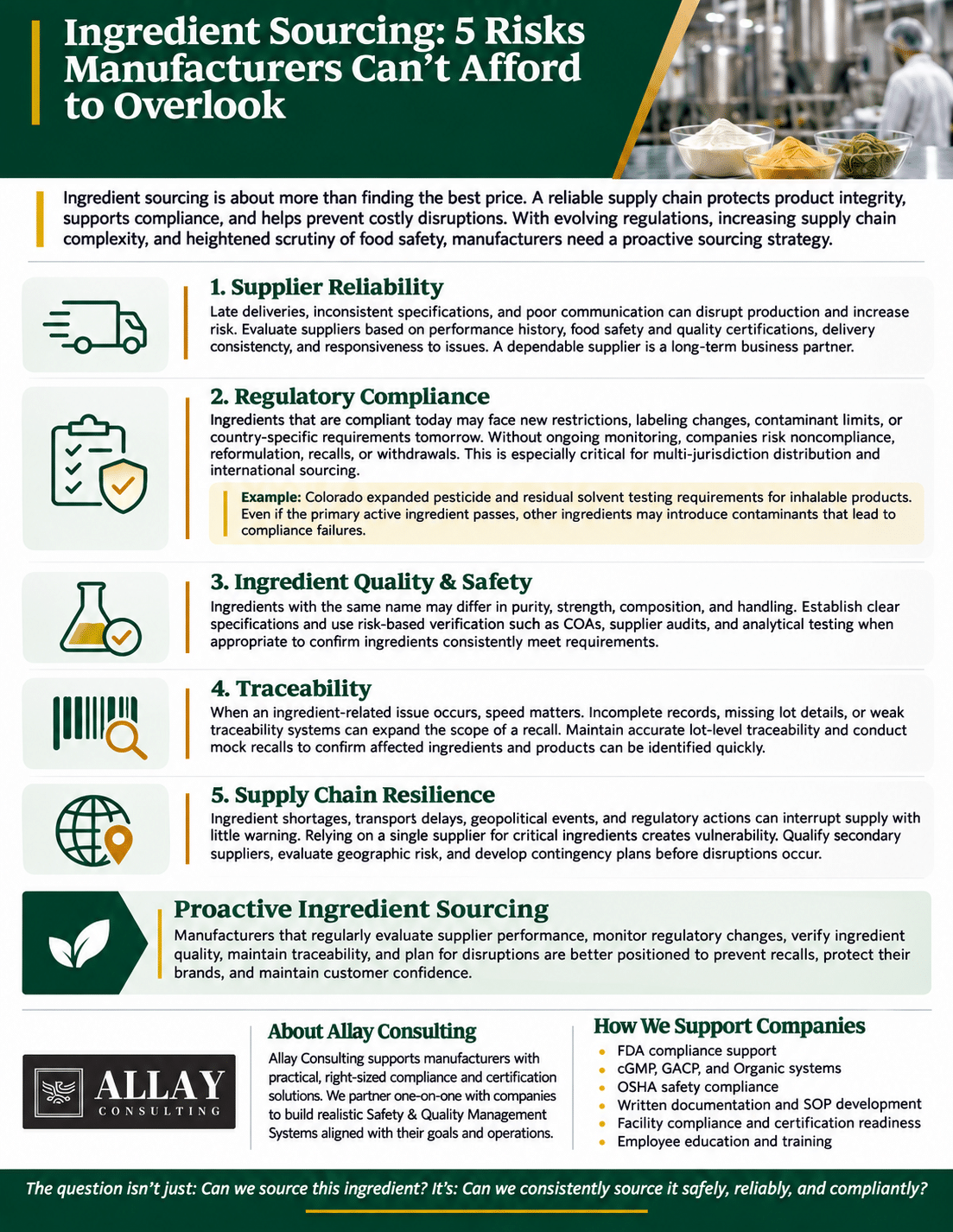
Ingredient Sourcing: 5 Risks Manufacturers Can’t Afford to Overlook
Why selecting the right ingredients, and the right suppliers, is essential to product quality, regulatory compliance, and business continuity. Ingredient sourcing is about more than finding the best price. A reliable supply chain plays a critical role in protecting product integrity, maintaining regulatory compliance, and preventing costly disruptions.
With evolving regulations, increasing supply chain complexities, and heightened scrutiny of food safety, manufacturers must take a proactive approach to sourcing. Here are five key considerations to strengthen your ingredient sourcing strategy.
1. Supplier Reliability: Can You Count on Your Suppliers?
A supplier’s ability to consistently deliver safe, quality ingredients is just as important as competitive pricing. Late deliveries, inconsistent specifications, and poor communication can disrupt production and introduce unnecessary risks.
Evaluate suppliers based on their performance history, food safety and quality certifications, delivery consistency, and responsiveness to quality concerns. A dependable supplier is a long-term business partner, not simply a source of ingredients. Regular performance evaluations help identify potential issues before they impact operations.
2. Regulatory Compliance: Are Your Ingredients Still Compliant?
Regulations are constantly evolving, and ingredients considered compliant today may face new restrictions, labeling requirements, or limitations tomorrow. Changes to allowable ingredients, contaminant limits, allergen labeling, and country-specific regulations can create compliance gaps. Without ongoing regulatory monitoring, manufacturers risk producing noncompliant products that may require costly recalls, withdrawals, or reformulation.
This is particularly important when sourcing ingredients internationally or manufacturing products distributed across multiple jurisdictions. For example, Colorado has expanded pesticide and residual solvent testing requirements for inhalable products. While the main active ingredient itself may meet these requirements, other ingredients used in the finished product can introduce contaminants that result in compliance failures. This highlights the importance of evaluating all ingredients against applicable regulatory requirements, not just the primary active ingredient.
Establish a process to monitor regulatory developments and periodically reassess ingredient compliance. Don’t assume an ingredient remains compliant simply because it has been used historically.
3. Ingredient Quality & Safety: Are You Getting What You Expect?
Not all ingredients are created equal, even when they share the same name. Differences in manufacturing processes, strength, purity, composition, and handling practices can significantly affect finished-product quality and safety.
Manufacturers should establish clear ingredient specifications and implement risk-based verification activities, including Certificates of Analysis (COAs), supplier audits, and analytical testing when appropriate. Verify that ingredients consistently meet established specifications and applicable food safety requirements.
4. Traceability: Could You Respond Quickly to a Recall?
When an ingredient-related issue occurs, the ability to rapidly identify affected products can determine the scope and financial impact of a recall.
Incomplete supplier records, missing lot information, or inadequate traceability systems can turn an isolated issue into a widespread disruption. Manufacturers should be able to trace ingredients from their suppliers through receipt, production, and finished-product distribution.
Manufacturers must maintain accurate lot-level traceability and periodically conduct mock recalls to evaluate how quickly affected ingredients and products can be identified.
5. Supply Chain Resilience: What Happens When a Supplier Fails?
Ingredient shortages, transportation delays, geopolitical events, and regulatory enforcement actions can unexpectedly interrupt supply. Relying on a single supplier for critical ingredients creates vulnerabilities, particularly when qualified alternatives are not readily available.
Consider qualifying secondary suppliers, evaluating geographic sourcing risks, and establishing contingency plans for essential ingredients. Build flexibility into your supply chain before disruptions occur. Alternative suppliers should be evaluated and approved before their ingredients are needed.
6. Proactive Ingredient Sourcing
Proactive ingredient sourcing is a critical component of food safety, regulatory compliance, and business continuity. Manufacturers who regularly evaluate supplier performance, monitor regulatory changes, verify ingredient quality, maintain traceability, and plan for disruptions are better positioned to prevent recalls, protect their brands, and maintain customer confidence.
The question isn’t just “Can we source this ingredient?” It’s “Can we consistently source it safely, reliably, and compliantly?”
Contact Us Today!
Learn how our consulting services can help move your business forward.